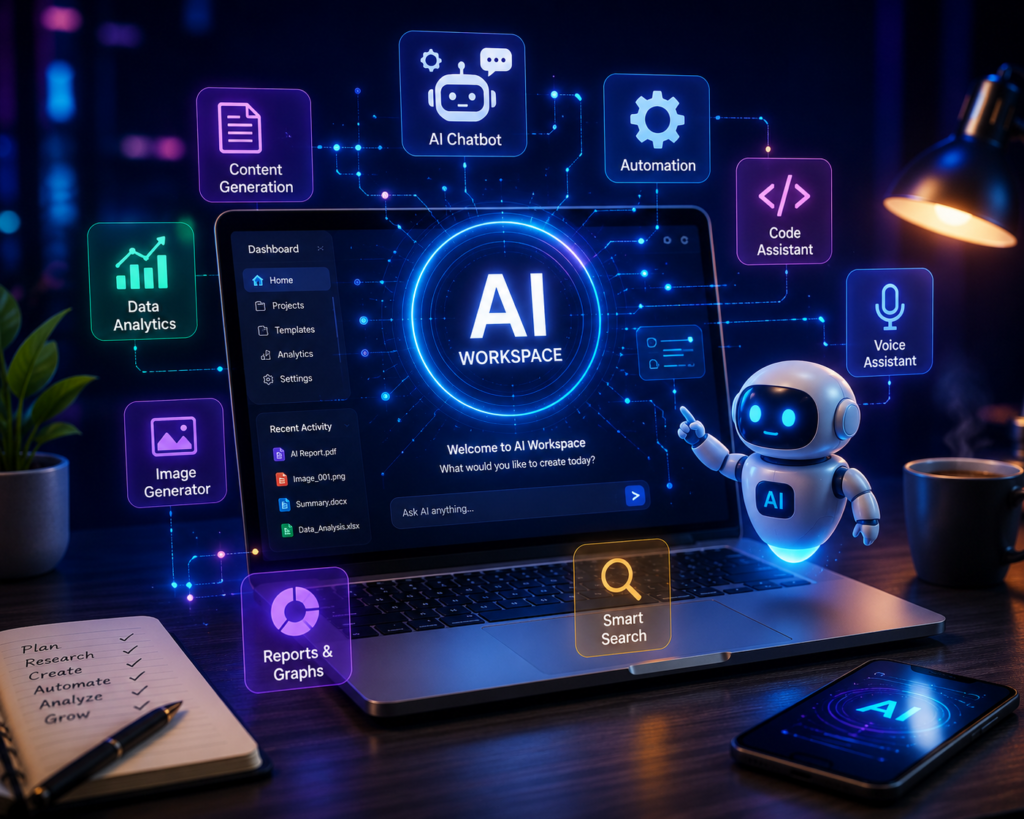
Maximising operational capacity in modern business structures commands a complete shift away from manual software execution. The deployment of top AI apps introduces advanced neural networks that independently manage dense data processing, creative prototyping, and continuous information management. By implementing these algorithmic layers, modern workforces can bypass systemic operational friction and drastically compress project delivery windows. Our empirical matrix highlights the top AI apps engineered to turn standard digital infrastructures into hyper-efficient technical assets.
⚡ Core Pillars of Next-Gen Automated Frameworks
Contemporary software engineering focuses on proactive assistance rather than reactive commands. When analyzing the top ai apps, our engineering laboratories stress-test several distinct functional benchmarks:
Predictive Context Extraction
Smart computational networks continuously trace active organizational databases and active digital communication channels to deliver resources before an employee explicitly requests them.
Cross-Format Information Synthesis
High-performance utilities effortlessly ingest contrasting media assets—such as raw voice audio, multi-layered visual files, and analytical spreadsheets—to generate unified business documentation.
Hardened Local Computation Circles
The most secure top ai apps manage their machine learning calculations inside localized hardware environments, preventing intellectual property from escaping into public cloud networks.
- Fluid operating system parity across mobile platforms.
- Automated verification of remote network ledgers.
- Direct application programming interface linkups.
- Instant text-to-voice audio modules.
🛡️ Our Validation and Quality Protocols
Isolating true enterprise-grade software suites from superficial marketing noise demands strict empirical analysis. We look completely past high-level brand promises to isolate verified performance results:
Independent Efficiency Audits
Our evaluation metrics are entirely self-funded, ensuring every single software ranking relies solely on raw computing speed and processing accuracy.
Iterative Lifecycle Monitoring
Because the broader automation landscape shifts rapidly, our team runs consistent diagnostic sweeps to verify that featured tools remain the true top ai apps globally.
Legacy Infrastructure Interoperability
We conduct deep compatibility testing across customized company databases, secure corporate networks, and primary communication architecture.
- Isolated data center execution testing.
- Granular cost-to-benefit calculations.
- Rigorous verification of data encryption layers.
- Exhaustive tear-downs of free versus paid pricing tiers.
📈 Tangible Returns on Automated Architecture
Adopting modern algorithmic layers triggers a compounding series of structural advantages that directly support long-term operational scaling:
Radical Hour Reclamation
Delegating routine data organization and report generation to automated scripts saves up to two-thirds of an average employee’s weekly workflow.
Radical Subscription Consolidation
Centralizing core team workflows around multi-capable top ai apps allows enterprises to safely dismantle fragmented, single-purpose software licenses.
Elastic Operational Expansion
Process vastly larger client profiles, extensive research documents, and dense content pipelines without the immediate requirement to scale human headcount.
- Informed, metrics-based execution choices.
- Systematic removal of data transfer errors.
- Real-time translation across minor dialects.
- Compressed timelines for staff technical training.
🔄 Our Structured Deployment Timeline
We smoothly transition your business away from fragmented, legacy applications into unified, intelligent systems using a reliable four-step deployment process:
1. Operation Jam Identification
We conduct an in-depth audit of your current digital setup to spotlight hidden time sinks that drain employee energy and billable hours.
2. Tailored Infrastructure Balancing
Our consultants map your exact operational budget directly against global software capabilities to discover the most cost-effective arrangement possible.
3. Deep Directive Customization
We construct and test precise system rules for your tools, completely wiping out software confusion and ensuring steady, predictable output quality.
4. Continuous Output Tuning
Our software engineers regularly assess system metrics to adjust configurations, implement updates, and continuously drive up your final return on investment.
📞 Connect with Our Systems Engineers
Are you ready to restructure your technical workspace and discover massive hidden pockets of productivity? Reach out to our technical integration team to design your optimized tool environment using the world’s top ai apps today.
Top AI Apps: Core Pillars of Next-Gen Automated Frameworks
Modern software ecosystems are shifting away from standalone tools toward interconnected, intelligent environments. The deployment of top AI apps introduces automated architectures that independently handle data processing, creative prototyping, and continuous information management. By implementing these advanced applications, enterprises can streamline complex operational bottlenecks and drastically reduce project delivery timelines.
Here are the critical pillars defining the next generation of productive artificial intelligence apps.
1. Advanced Analytical Engines
Data is only valuable if it can be interpreted instantly. Modern AI analysis tools process unstructured databases to extract actionable market intelligence without human intervention. These systems spot historical trends, financial anomalies, and emerging consumer behaviors in seconds, giving leadership teams an immediate strategic edge.
2. Autonomous Content and Code Ecosystems
Generative platforms have evolved past simple text creation into full-scale production assets. Current applications write production-ready code, generate high-fidelity UI designs, and draft technical documentation simultaneously. This automated workflow allows developers to focus on architecture and system security rather than repetitive formatting.
3. Cognitive Workflow Automation
Traditional automation relies on fixed, rule-based logic that breaks whenever a variable changes. Next-gen AI apps utilize dynamic reasoning to adapt to shifting project parameters on the fly. They can route internal support tickets, manage inventory supply lines, and respond to client inquiries based on context rather than pre-written scripts.
